 Behçet’s disease presents a unique diagnostic challenge – everyone with the condition experiences mouth sores, yet no single test can confirm its presence. This chronic inflammatory condition can affect multiple systems throughout your body, from eyes and vision problems in behçet’s disease to neuro behçet’s disease affecting your central nervous system. Understanding behçet’s disease symptoms, what causes behçet’s disease, and behçet’s disease diagnostic criteria is crucial for proper management. We’ll walk you through the symptoms, causes and diagnostic process in this piece, as well as available treatment options for this rare condition.
What is Behçet’s disease?
Understanding the rare inflammatory condition
Behçet’s disease is a chronic inflammatory condition caused by vasculitis, which means inflammation damages both arteries and veins throughout your body. The disease earned its alternate name, Silk Road disease, from its geographic clustering along the ancient trading route connecting Asia with the Middle East and southern Europe.
This vasculitic disorder stands apart from other conditions because it can involve blood vessels of all sizes and types. Behçet’s disease has the capacity to affect small, medium and large vessels, which explains why symptoms can appear in nearly any organ system. Turkish dermatologist Hulusi Behçet gave the condition its name when he presented three cases of patients with a triad of oral ulceration, genital lesions and recurrent eye inflammation in 1937.
The disease follows a relapsing-remitting pattern in most people. Symptoms flare up and then improve, with the time between attacks ranging from a few days to years. Some people with more severe disease experience symptoms that vary in intensity but remain present. The mechanism involves an autoimmune response, where the body’s defense system attacks its own healthy tissues by mistake. The exact cause remains unclear, but genetic factors and environmental triggers appear to play roles in disease development.
Who gets Behçet’s disease?
The disease most often begins between ages 20 and 30, though children and older adults can develop the condition. The mean age of onset falls within the second to fourth decade of life.
Gender distribution varies by a lot across geographic regions. Middle Eastern countries see the disease affect more males, with male-to-female ratios reaching 3.8:1 in Israel, 5.3:1 in Egypt and 3.4:1 in Turkey. Asian countries like Germany, Japan and Brazil show the disease is more common in females. The United States shows a female predominance with a 5:1 female-to-male ratio.
Males experience more severe disease, especially in Mediterranean regions. Vascular disease and arterial involvement pose greater risks in male patients.
Geographic distribution and prevalence
Behçet’s disease clusters along the historic Silk Road, with prevalence decreasing as distance from this region increases. Turkey has the highest prevalence worldwide, with about 420 cases per 100,000 people. The Mediterranean basin and Middle East follow with up to 300 cases per 100,000 people.
The Far East sees prevalence reach about 15 cases per 100,000 people in some regions, while Japan reports 13.5 cases per 100,000 population. Iran and other Middle Eastern countries show prevalence rates ranging from 13.5 to 22 cases per 100,000 population.
The disease remains much rarer in Western populations. The United States has prevalence estimates ranging from 0.33 to 7 cases per 100,000 people, though some regions like the American Southwest report higher rates of 8.9 to 10.6 cases per 100,000 population. The United Kingdom has an estimated 0.64 cases per 100,000 people.
Time trend studies indicate increasing prevalence over the last several years, probably due to improved disease recognition and immigration from endemic areas. To cite an instance, prevalence in Japan increased from 6.3 per 100,000 in the 1970s to 13.5 per 100,000 by 1991.
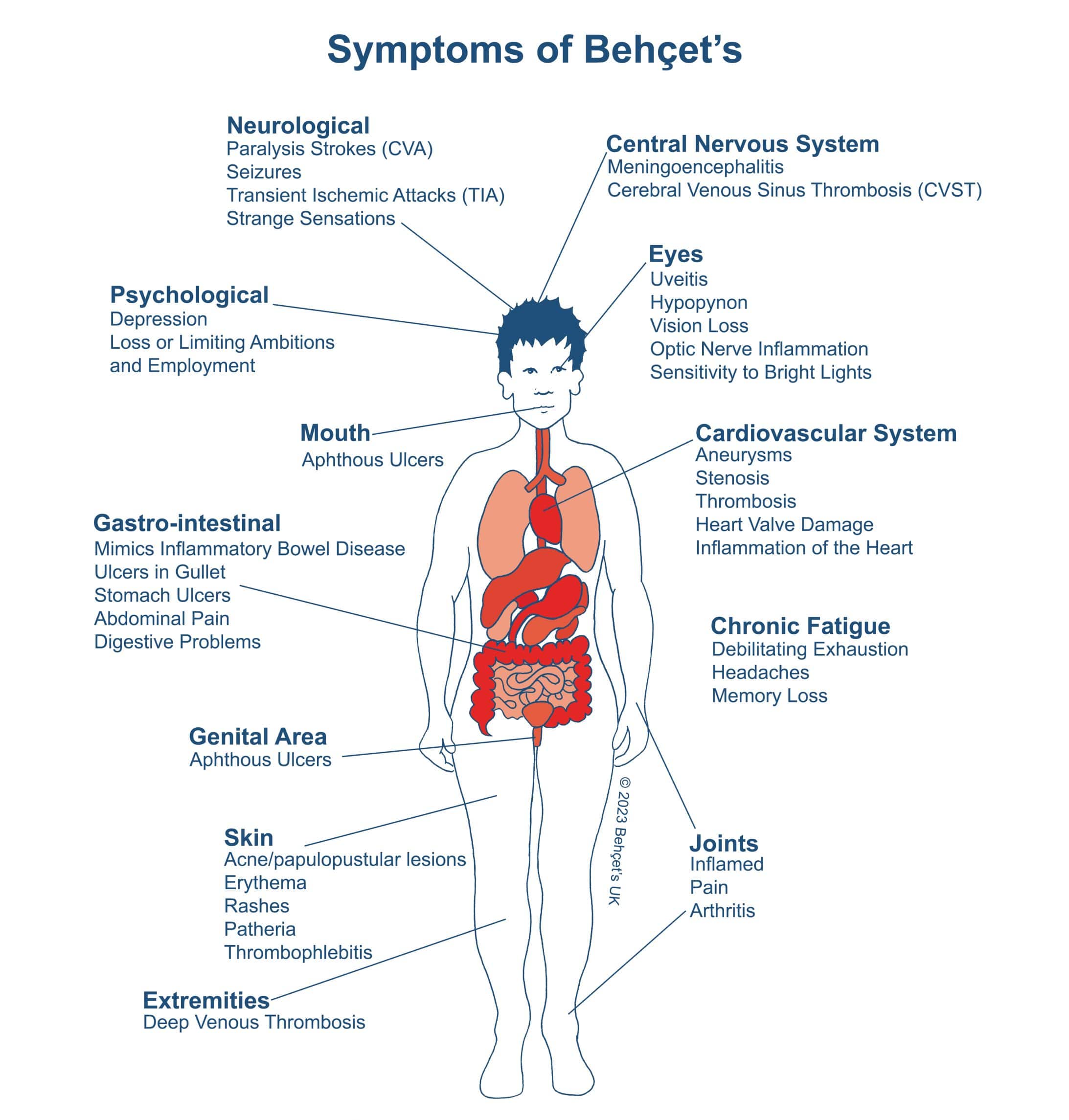 Behçet’s disease symptoms
Mouth and genital sores
Oral ulcers rank as the most recognizable feature and occur in 97% to 99% of patients. They often represent the original sign you’ll notice. These lesions appear painful, recurrent and multiple. They affect the soft palate, hard palate, buccal mucosa, tongue, gingiva, lips and tonsils. The ulcers resemble canker sores but tend to be more numerous and frequent. Minor aphthae are most common. They appear round and less than 10 mm in diameter with pale centers and red borders. More than 90% of oral ulcers heal without scarring within one to two weeks.
More than 80% of patients develop genital lesions. Males experience these ulcers on the scrotum in 90% of cases. Females experience them on the vulva or vagina. More than 70% of genital ulcers heal with scarring, unlike oral lesions. These sores are deeper, last longer and prove more painful than their oral counterparts.
Behçet’s disease eyes and vision problems
Eye involvement affects more than 50% of patients, though it’s more common in males and younger patients. The typical presentation is uveitis that is relapsing, chronic, bilateral and involves both anterior and posterior uveal tracts. Anterior uveitis causes erythema and photophobia. Posterior uveitis causes vision loss. Blindness occurs in more than 75% of patients without treatment. Retinal vasculitis can progress to permanent blindness. Panuveitis is the most frequent presentation at 60.2%, followed by posterior uveitis at 28.8% and anterior uveitis at 11.0%.
Skin problems and joint pain
Up to 75% of patients experience cutaneous manifestations. Erythema nodosum appears as red, tender swellings on the legs. Acneiform lesions resemble acne-like spots called pseudofolliculitis. These skin lesions heal within 14 days but recur frequently.
Fifty percent of patients develop inflammatory, non-erosive, non-deforming arthritis. The condition presents as oligoarthritis that can be symmetric or asymmetric. Knees are the most involved joint, followed by ankles, wrists and elbows.
Vascular involvement and blood vessel inflammation
Arterial and venous involvement occurs in 25% of patients, more often in males. Superficial and deep thrombophlebitis of the lower extremities represents the most common vascular manifestation. Pulmonary artery involvement with aneurysm formation stands as unique to Behçet’s disease and is the primary cause of death.
Neuro Behçet’s disease and central nervous system effects
Central nervous system involvement appears in 5% to 10% of patients. Parenchymal involvement affects 80% of these cases, most often in the brainstem. This produces cerebellar, pyramidal and sensory signs. Nonparenchymal involvement characterized by dural sinus thrombi occurs in 20% and causes headaches and papilledema.
Gastrointestinal and other organ symptoms
Mucosal ulcerations resembling oral lesions can develop in the terminal ileum, cecum, colon and esophagus. Symptoms include abdominal pain, nausea, vomiting, diarrhea and gastrointestinal bleeding. Extensive ulcerations, especially ileocecal lesions, may cause perforation.
What causes Behçet’s disease?
Scientists remain unable to pinpoint a single definitive cause for what triggers Behçet’s disease. The common theory suggests a complex interplay between genetic predisposition, immune system malfunction and environmental factors.
Autoimmune response and immune system dysfunction
The body’s defense mechanism appears to mistakenly attack healthy tissues in people with this condition. This autoimmune response involves inflammation of blood vessels throughout the body. Behçet’s disease demonstrates characteristics of both autoimmune and autoinflammatory disorders.
The condition is different from typical autoinflammatory diseases in several ways. Onset usually occurs in adulthood rather than childhood. The disease shows only mild response to therapies targeting IL-1. Because of its association with HLA class I alleles, like spondyloarthropathies, experts have introduced the concept of Behçet’s as a major histocompatibility complex I-opathy.
Neutrophils become hyperactive in affected individuals. They show increased chemotaxis, phagocytosis and superoxide production. Complex interactions between T cells, antigen-presenting cells and neutrophils drive the immune pathogenesis. Patients show increased numbers of activated gamma-delta T cells in circulation and mucosal lesions. These cells produce inflammatory cytokines including IFN-γ, TNF-α and IL-8.
Genetic factors and HLA-B51 gene marker
The HLA-B51 gene marker stands as the strongest genetic risk factor identified. Carriers of HLA-B51/B5 face approximately a six-fold increased risk of developing the disease compared to non-carriers. The gene appears in one-third to two-thirds of patients. Frequencies range from 50% to 72% depending on the population.
Geographic variation in HLA-B51 prevalence mirrors disease distribution. Turkish patients show frequencies of 54% to 82%. Japanese patients show 44.5% and Iranian patients 48.9%, while Northern European and American populations show only 15%. HLA-B51 accounts for approximately 19% to 20% of genetic risk for the disease.
Several other genes contribute to susceptibility. Researchers have identified associations with ERAP1, which processes microbial proteins in white blood cells. The ERAP1 variant increases risk only in individuals with HLA-B51. Variants near the CCR1 gene affect how infection-fighting blood cells migrate to sites of invading microorganisms. The STAT4 gene shows associations with Behçet’s disease. Different variants increase risk for other autoimmune diseases including rheumatoid arthritis and lupus.
The IL10 gene locus shows disease-associated variants that associate with reduced expression of this anti-inflammatory cytokine. Other susceptibility genes include IL23R-IL12RB2 loci and tumor necrosis factor genes.
Environmental triggers and risk factors
Exposure to infectious agents appears to initiate an auto-inflammatory response in genetically predisposed individuals. Hypersensitivity to Streptococcus sanguinis antigens has suggested a pathological role. Heat shock proteins from bacteria show considerable homology with human proteins and potentially trigger cross-reactive immune responses.
Patients demonstrate less diverse oral and fecal microbial communities compared to healthy individuals. The oral flora shows reduced diversity, with Haemophilus parainfluenzae as the most overabundant species.
An association between oral ulcer recurrences and external events occurs in 78.3% of patients. Specific foods including nuts, cheese, citrus fruits, pineapple and strawberries have been reported as triggers. Menstruation triggers skin and mucosal lesions in women, while testosterone associates with neutrophil activation in men.
Behçet’s disease diagnostic criteria
Clinical diagnosis based on symptoms
Diagnosing Behçet’s disease relies on clinical manifestations after ruling out other possible causes. No specific laboratory, histopathologic, or genetic findings exist for diagnosis. The average time to reach a diagnosis spans 5.3 years, in part because manifestations may occur intermittently and as long as 8 years may pass until a second symptom appears.
The International Study Group (ISG) criteria remain the most commonly used diagnostic set. According to these criteria, recurrent oral ulcers appearing at least three times within 12 months serve as the foundation. You must also present at least two additional features: genital ulcers, eye lesions, skin lesions, or a positive pathergy test. These criteria showed 95% sensitivity and 98% specificity.
But the ISG criteria have notable limitations. They exclude major organ involvement such as vascular, neurologic, and gastrointestinal manifestations. A study tracked 189 suspected patients for 3.2 years. Only 37.6% were classified as Behçet’s disease according to ISG criteria during follow-up.
The International Criteria for Behçet’s Disease (ICBD), published in 2014, addressed these shortcomings through a point-based system. Oral ulcers, genital ulcers, and ocular lesions each receive 2 points. Skin lesions, neurological involvement, and vascular manifestations receive 1 point each. Patients scoring 4 points or above meet the diagnostic threshold. The ICBD criteria showed 94.8% sensitivity, much higher than ISG’s 85.0%. Specificity reached 90.5%, lower than ISG’s 96% but still high enough.
Laboratory tests and pathergy test
Blood tests and other laboratory evaluations help rule out alternative conditions but cannot confirm Behçet’s disease. The pathergy test represents the only diagnostic test used in classification criteria. Your healthcare professional inserts a sterile needle into your forearm skin and examines the area 24 to 48 hours later. A positive result shows as a 2 mm or greater papule developing at the insertion site.
Pathergy test positivity varies by geography. Only 50% of patients in Middle Eastern countries and Japan show positive reactions. North American patients show nowhere near as many positive results.
Ruling out other conditions
Several conditions mimic Behçet’s disease symptoms, including inflammatory bowel disease, systemic lupus erythematosus, reactive arthritis, and herpetic infections. Crohn’s disease can present with all manifestations of Behçet’s disease, including gastrointestinal, oral, ocular, and skin involvement. Diagnosis becomes especially challenging in patients presenting only with major organ involvement without oral ulcers. Experts in countries with high prevalence may diagnose these cases through clinical judgment based on specific findings like genital ulcers, ocular involvement, or vascular manifestations.
Treatment options explained
No cure exists for Behçet’s disease, but treatment can control symptoms and prevent organ damage. Your healthcare approach depends on disease severity and which organs are affected.
Topical treatments to manage mild symptoms
Topical corticosteroids applied to affected areas serve as first-line treatment for mild disease. Skin creams, gels and ointments that have corticosteroids reduce swelling and pain from skin and genital sores. Special mouthwashes with corticosteroids and pain-relieving agents soothe mouth ulcers. Corticosteroid eye drops provide relief for mild eye inflammation.
Colchicine helps with recurrent mouth and genital sores and can ease joint swelling. The FDA approved apremilast to treat mouth sores caused by Behçet’s disease, though side effects may include weight loss and depression.
Corticosteroids to control inflammation
Prednisone and other corticosteroids ease inflammation throughout your body. Healthcare professionals often prescribe them with immunosuppressants to boost effectiveness. Side effects include weight gain, heartburn, high blood pressure and bone thinning.
Immunosuppressants and disease-modifying drugs
Medications that reduce immune system activity include azathioprine, cyclosporine and cyclophosphamide. These drugs prevent the immune system from attacking healthy tissues but increase infection risk and can affect liver and kidney function. Interferon alfa-2b may be used alone or combined with other medicines for skin sores, joint pain and eye irritation.
Biological therapies and TNF inhibitors
TNF inhibitors block tumor necrosis factor and treat resistant symptoms. Infliximab and adalimumab prove effective for severe disease, especially ocular and vascular involvement. Both drugs showed efficacy in achieving remission in patients with mucocutaneous and vital organ involvement refractory to traditional therapy.
Treatment approaches for specific organ involvement
Sight-threatening eye disease requires high-dose glucocorticoids combined with azathioprine or TNF inhibitors. Treatment for gastrointestinal involvement has corticosteroids, azathioprine and TNF inhibitors that work after conventional therapy fails. Vascular manifestations need immunosuppressive agents, with cyclophosphamide and high-dose corticosteroids recommended for arterial aneurysms.
Managing flares and long-term care
Treatment goals focus on achieving remission, which may take several months to years. Your doctor may reduce medication dosage after sustained remission. Most people respond well and enter remission, stopping medication for extended periods eventually. Behçet’s disease often improves with age. Many achieve medication-free remission over time.
Behçet’s disease presents diagnostic challenges, yet understanding its symptoms makes early recognition possible. If you familiarize yourself with the distinctive signs like recurrent mouth sores, genital ulcers and eye inflammation, you can seek appropriate medical care sooner. Treatment options have advanced by a lot, though no cure exists. Most people respond well to therapy and many achieve long-term remission as the disease often improves with age. The key lies in working closely with your healthcare team to identify which organs are affected and tailor treatment therefore. Note that proper management can prevent serious complications, especially vision loss and vascular damage. Early intervention gives you the best chance to maintain quality of life.
FAQs
Q1. How long does it typically take to get diagnosed with Behçet’s disease? The average time to reach a diagnosis is approximately 5.3 years. This delay occurs because symptoms may appear intermittently, and as long as 8 years can pass between the first symptom and the appearance of a second one, making it challenging for doctors to identify the pattern.
Q2. Is Behçet’s disease more common in men or women? Gender distribution varies by geographic region. In Middle Eastern countries, the disease affects more males, with ratios as high as 5:1 in some areas. However, in Asian countries like Japan and Germany, as well as in the United States, the disease is more common in females, with a 5:1 female-to-male ratio in the U.S.
Q3. Can Behçet’s disease cause permanent vision loss? Yes, eye involvement is a serious complication affecting more than 50% of patients. Without proper treatment, blindness occurs in more than 75% of patients with eye involvement. The condition typically causes uveitis and retinal vasculitis, which can progress to permanent vision loss if left untreated.
Q4. What is the pathergy test and how does it help diagnose Behçet’s disease? The pathergy test is the only diagnostic test used in classification criteria for Behçet’s disease. A healthcare professional inserts a sterile needle into the forearm skin and examines the area 24 to 48 hours later. A positive result shows as a 2mm or greater papule at the insertion site, though test positivity varies geographically.
Q5. Will I need to take medication for Behçet’s disease for the rest of my life? Not necessarily. Treatment goals focus on achieving remission, which may take several months to years. After sustained remission, doctors may gradually reduce medication dosage. The disease often improves with age, and many people achieve medication-free remission over extended periods.
We Help Patients with Behçet’s Disease and Other Conditions
Rheumatology is a broad field, which treats many conditions including those related to autoimmune disease, arthritis, bone health, and many regional musculoskeletal conditions presenting as joint, muscle, and soft tissue pain.
> Learn More
Contact Us (859-331-3100) For More Information or to Request an Appointment
—
 About Tristate Arthritis and Rheumatology
Tristate Arthritis and Rheumatology is the first and largest Rheumatology practice in the Northern Kentucky area. Founded by Dr. Arthur Kunath in 1986, our rheumatology practice now consists of six doctors who are board certified in both Internal Medicine and Rheumatology and a Physician Assistant. Patients see one doctor (except in emergencies), thereby assuring continuity of care and an individualized doctor-patient atmosphere giving the physician the ability to establish personalized and detailed relationships. Our doctors have received numerous awards, including being listed as “Top Doctors” in Cincinnati Magazine, receiving the Patient’s Choice Award, the Most Compassionate Doctor Award, and the American College of Rheumatology’s “My Doc Rocks” award.